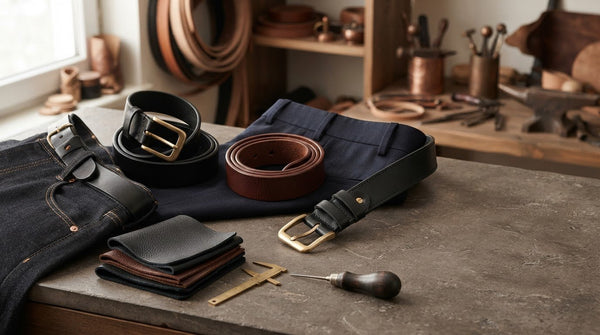
Noppa Belt Production Stages

Leather Belt Production: Process Stages
1. Raw Material Procurement (Raw Hide)
Raw hide (skin) obtained from large animals is procured.
Leather is generally supplied from slaughterhouses and preserved by salting before production.
2. Tanning
The leather undergoes chemical or vegetable processes to prevent decay and gain flexibility.
Most common methods: Chrome tanning or vegetable (natural) tanning.
3. Drying and Resting
Tanned leather is dried by removing moisture and rested for a period.
This process allows the leather to stabilize and become ready for processing.
4. Cutting (Strap Cutting)
The leather is cut into strips in belt sizes.
The width and thickness are determined according to the customer or model requirements.
5. Edge Finishing
The belt edges are sanded, smoothed, and rounded.
Then they are coated with edge paint or beeswax.
6. Dyeing & Polishing
The leather belt is colored (e.g., black, brown shades).
Finally, it is polished for shine, water resistance, and aesthetics.
7. Hole Punching and Accessory Assembly
Belt holes are punched with a drill or die.
Buckles, rivets, or stitching are assembled.
8. Quality Control
All belts are inspected for shape, dimensions, durability, and aesthetics.
Defective products are separated, and sound products proceed to packaging.
9. Packaging and Shipping
Belts are placed in special boxes or hangers without folding.
They are prepared for shipping with product information and brand labels.
You can view all our genuine leather belt models in our genuine leather belt collection — they are produced by hand in our workshop in Gerede.