How to Measure for a Belt? The Easy Way to Find the Right Size

If your waist measures 90 cm, should you buy a 90 cm belt? Not necessarily. Waist circumference and belt size are not the same, and using your pant size as a direct guide to belt size can also be misleading. The answer to how to measure for a belt depends on where you take the measurement and how you match the result with the size listed in the product information.
To find the right size, you can use a tape measure or measure a belt that already fits you well. Practical methods include measuring around your waist at the point where you normally wear your belt or finding the distance from the pin in the belt buckle to the hole you use most often. The key is not to confuse your waist circumference with the length of the belt and not to decide based solely on your pant size.
In this article, you will learn two measurement methods step by step, compare your measurement with the size listed in the product information, and confirm it with a checklist before purchasing. Once you have determined your size, you can use this information when considering Noppa leather belts, which are handcrafted from genuine buffalo and cowhide in Gerede.
Key Takeaways
- When looking for the answer to how to measure for a belt, consider waist circumference, your current belt size, and your pant size separately.
- When measuring your current belt, use the distance from the pin in the buckle to the center of the hole you use most often.
- Pant size is only an approximate clue; make your selection by directly comparing the measurement you took with the measurement definition in the product information.
- Place the tape measure at the level where you wear your belt. Keeping it crooked or tightening it around your waist can change the result.
- After determining your size, browse Noppa’s genuine leather belts, handcrafted in Gerede.
How to measure for a belt and why the right size matters?
The size you are looking for when choosing a belt is not the same as your waist circumference or the total end-to-end length of the belt. Your waist circumference is measured around your body, while belt size depends on how the belt is measured and how it is stated in the product information. Knowing this distinction reduces the risk of matching your measurement with the wrong size.
The right size helps you wear the belt comfortably at your usual wearing point. A belt that is too short may not close or may restrict your movement, while the end of a belt that is too long can be uncomfortable during use. The goal is not just to find a number, but to compare your measurement with the size description of the product you have selected using the same measurement approach.
Are belt size, waist circumference, and belt length the same?
Waist circumference is the measurement taken around your body with a tape measure. Belt length can describe the physical length of the accessory, and product size information can also be shown in centimeters or with values such as 90 or 95. These representations may not correspond to the same measurement point on every product. You can learn more about the general meaning of body measurements here. When choosing a belt, use the measurement method explained on the product page as your guide.
For example, even if your waist circumference is 90 cm, do not assume that the size labeled “90” on the product necessarily corresponds to this waist circumference. Size information may refer to the length between specific points on the belt. Therefore, rather than relying on a universal conversion rule, compare your measurement using the same method as the product description.
Which method should you choose before taking your measurement?
If you have a belt that fits you and that you wear regularly, taking a measurement from your current belt is a good place to start. This way, you can use the wearing style you are accustomed to as a reference. If you do not have a suitable belt, you can measure your waist circumference from the level where you normally wear your belt. You will see the application of both methods separately in the steps below.
Whichever method you choose, take the measurement from the point where the belt will be worn. If you wear your belt at the waistline of your pants, place the tape measure at that level as well. If you plan to wear it at the waist of a garment or at a different height, determine the measurement point accordingly. Results taken from different levels may not be the same.
- If you have a suitable belt: Measure using the current belt method.
- If you do not have a reference belt: Measure your waist circumference with a tape measure.
- When you see size information: Check the product description to see between which points the measurement was taken.
Making this distinction from the start makes the rest of the measurement easier. You can proceed without confusing your waist circumference with the total length of the belt or accepting your pant size as a definitive result.
How to measure step by step with a tape measure and your current belt
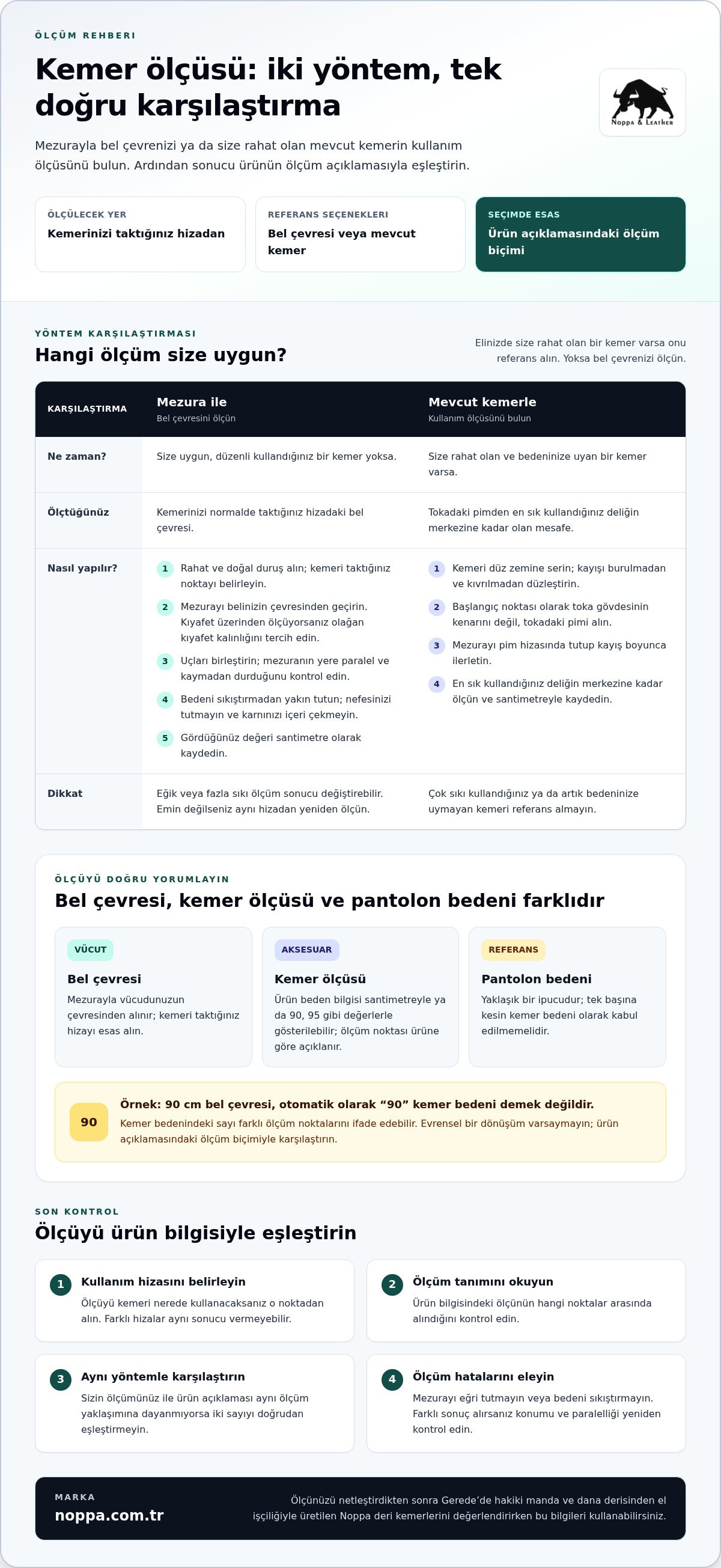
The practical answer to how to measure for a belt depends on the measurement tool you have. A tape measure gives your waist circumference, while your current belt gives you the measurement for your usual wearing style. Apply the methods separately and record the result in centimeters. Then, check the size description on the product page to see between which points the measurement was taken and compare.
How to measure your waist circumference with a tape measure
Wrap the tape measure around your waist at the level where you normally wear your belt. If you wear it at the waist of your pants, take the measurement at that level. Also take into account the usual thickness of the clothes your belt passes over in daily use. Taking a measurement over thin clothing and then using the belt with thicker garments may affect the result.
- Stand in a comfortable and natural position. Determine the point where you wear your belt.
- Wrap the tape measure around your waist. If you will measure over clothing, choose the usual thickness of the clothes you wear in daily use.
- Join the ends of the tape measure and check that it is level with the ground. It should not slip up or down at the front or back.
- Hold the tape measure close enough to your body to avoid leaving a gap, but without tightening it. Do not hold your breath or pull in your stomach.
- Record the value you see on the tape measure in centimeters. For proper positioning, you can also review the steps for taking waist measurements.
If the tape measure is slanted or too tight, you may read the result differently than it actually is. If you are unsure, remove the tape measure and measure again from the same level. If the two measurements are significantly different, check its position and whether it is level with the ground.
How to take the right measurement from your current belt
Choose a belt that is comfortable for you; do not use a belt that is too tight or no longer fits your size as a reference. Keep in mind the position of the strap when it is buckled and the hole you normally use. In this method, you measure the distance up to the wearing point, not the entire length of the belt.
- Lay the belt flat on a level surface. Flatten the strap without twisting or creasing it.
- Use the pin in the buckle as the starting point. Do not start measuring from the outer edge of the buckle body.
- Hold the end of the tape measure at the level of the pin and move it along the strap.
- Measure up to the center of the hole you use most often. Record the value in centimeters.
When comparing this measurement with the product’s size description, also consider the measurement definition used by the manufacturer. If your measurement and the product description are not based on the same method, do not match the two numbers directly. Once you have determined your size, you can browse Noppa leather belts, which are handcrafted from genuine buffalo and cowhide in Gerede.
How to compare pant size, waist circumference, and belt size
All three pieces of information help you choose a size, but they do not show the same thing. Waist circumference is measured directly around the body. The hole you use on your current belt gives a clue about the belt setting you are accustomed to. Pant size, on the other hand, is an approximate reference that can vary depending on the cut and brand. When comparing, also note the measurement method; looking only at the numbers is not enough.
Waist circumference
The measurement taken around the body with a tape measure at the level where you wear your belt. Do not assume it should be the same number as the belt size.
Current belt size
The distance measured from the pin in the buckle to the center of the hole you use most often. Compare whether it covers the same points as the measurement description in the product description.
Pant size
The clothing size found on the label or in the product information. Due to the cut, waistline, and wearing preference, it does not provide a definitive belt size on its own.
For example, you can record your waist circumference and the measurement of the belt you use separately in centimeters. If the two numbers are different, do not immediately assume one of them is wrong. First, determine what each one measures and which method the size information in the belt product is based on.
Can you determine belt size from your pant size?
Pant size does not provide a definitive result on its own for choosing a belt. The same person may wear pants with different cuts or at different waistlines. The preference to wear pants looser or more fitted also makes it difficult to match the size on the label one-to-one with the point where the belt is worn. Therefore, use your pant size as helpful information to check your actual waist measurement or your current belt size.
First, determine your size using a tape measure or a suitable current belt. Then, evaluate its general consistency with your pant size. A difference between your pant size and your measurement does not automatically mean you measured incorrectly; the wearing level and the product’s size definition can also make a difference.
What should you do if the size chart and measurement result do not match?
First, review your own measurement again. If you used a tape measure, check the level where you wear your belt and whether the tape measure was held straight. If you measured your current belt, confirm that you started from the pin in the buckle and measured to the center of the hole you use.
Then, compare the starting and ending points of the measurement in the product description with your own measurement. If the description gives the total length of the belt, do not match this value directly with your waist circumference. The fact that the size name or centimeter value appears the same as yours is also not sufficient on its own. Brands and products may use different size representations; do not make your selection based on a universal conversion assumption.
- Note which method you used to take your measurement.
- Read the measurement definition and size chart on the product page.
- Make sure the comparison is based on the same measurement points.
Make your final decision by directly comparing your measurement with the measurement information in the product description. Considering pant size as a helpful check rather than a definitive measurement makes it easier to make the right match.
How to avoid common mistakes when measuring for a belt
A small slip in measurement can create unnecessary hesitation when comparing product sizes. This is why, in addition to how to measure for a belt, the conditions under which you take the measurement also matter. Place the tape measure at the level where you wear your belt. A value taken from a narrower or wider point on the waist may not accurately reflect the belt’s wearing measurement.
What are the small mistakes that change the measurement?
If the tape measure is too tight around your body, it may show the measurement as smaller than it is, while leaving a gap may make it appear larger. If the tape measure slants up or down around your waist, the distance it measures will change. When measuring over clothing, take into account the usual thickness of the clothes you wear in daily use; a measurement taken over thin clothing may not fully account for wearing the belt with thicker garments.
If you are measuring your current belt, use the hole you use most often as a reference. A value taken based on another hole you do not use will not show the actual point where you wear the belt. Determine the hole you use, measure from the pin in the buckle to the center of that hole, and record the result in centimeters.
How can you confirm the measurement before ordering?
Repeat your measurement one more time using the same method. If you used a tape measure the first time, place the tape measure at the same level, under the same clothing conditions, and with similar tension for the second measurement. If you are measuring your current belt, use the same hole and starting point. Changing the method makes it harder to understand why the results came out differently.
When comparing the centimeter value you recorded with the size information in the product description, read the measurement definition. Where is the product measurement taken from on the belt, and does it cover the same points as your measurement? Do not rely solely on the same centimeter number or a size name that looks similar. First, clarify the size information; the width or appearance of the belt cannot replace this measurement check.
Final checklist:
- I held the tape measure at the level where I wear my belt in daily use.
- I took the measurement without tightening or leaving it loose, and held it level with the ground.
- If I measured over clothing, I took into account the usual thickness of my clothes.
- I chose the hole I use most often on my current belt as the measurement point.
- I recorded the value in centimeters and compared it with the measurement definition in the product description.
If any of these items are missing, complete the measurement and check again. Once you have determined your size, browse the Noppa leather belts by reviewing the size descriptions. The belts are handcrafted from genuine buffalo and cowhide in an atelier in Bolu Gerede.
Browse Noppa leather belts after finding the right size
After completing your measurement, the next step is to match this value correctly with the size information of the belt you have selected. The answer to how to measure for a belt does not end with the measurement; understanding how the measurement is defined in the product information is also part of choosing a size. Note your waist circumference or the result you got from your current belt and compare it with the measurement method in the product description.
Where should you look for size information when browsing leather belts?
Look at how the size is given in the product description. Does the measurement describe the length between specific points on the belt, or is another size representation used? Make sure you are comparing it with your own measurement using the same method. Do not assume that the same size name represents the same centimeter value on every product; make your selection based on the product’s own description.
For example, if you measured your current belt from the pin in the buckle to the hole you use, check whether the value in the product information is also related to these points. Waist circumference and belt length are not the same. If the definition on the product page is based on a different measurement point, use the description as your guide rather than matching the numbers directly.
Material and production information for Noppa belts
Noppa belts are handcrafted in an atelier in Bolu Gerede. 100% genuine buffalo and cowhide are used in production. Once you have determined your size information, you can evaluate the size description and the type of leather together when browsing the products. This way, your selection is based not only on the product’s appearance but also on your size and the material information.
Natural leather and atelier craftsmanship are tangible characteristics of the belts. Do not make your size selection based on guesswork; instead, compare your own measurement with the relevant product description. This way, you can avoid the misconception that the same size name automatically corresponds to the same measurement on different products.
If you have recorded your size, follow this order when browsing the products:
- Read the product description to see which measurement the size information is based on.
- Compare your own measurement using the same method and points.
- Do not accept the size name as sufficient on its own; also evaluate the product’s measurement description.
When the measurement and material information are clear together, making a decision becomes easier. You can evaluate the genuine buffalo and cowhide Noppa belts handcrafted in Gerede by browsing leather belts suitable for your size.
Note your size, make your selection with confidence
Keep your size note next to the product description when choosing a belt. This way, you will not confuse your waist circumference, your current belt size, and your pant size while checking the size information. Turn your answer to “How to measure for a belt?” into a concrete selection: make sure that your own measurement method and the product’s size information are based on the same points.
Determining the right size is the first step to finding a belt that will be comfortable to wear in daily use. When making your final decision, evaluate the product’s measurement description and material information together. Noppa belts are handcrafted from genuine buffalo and cowhide in an atelier in Bolu Gerede.
If your size is ready, browse the products and discover Noppa leather belts. Use your measurement as a reference, determine the option suitable for you based on the descriptions, and choose your belt with confidence.
Frequently Asked Questions
Where is the tape measure placed when measuring for a belt?
Place the tape measure at the waistline where you wear your belt. If you wear your belt through the belt loops of your pants, determine the measurement point at that level as well. Stand straight and wrap the tape measure around your body without pressing it against your body. To find the correct answer to how to measure for a belt, check that the tape measure remains at the same level at the front and back. During measurement, your clothing should represent what you wear in daily use.
How to measure for a belt from your current belt
Lay your comfortable belt flat on a level surface. Measure from the pin in the buckle along the strap to the center of the hole you use most often. Do not include the end of the strap before the buckle or the full length of the belt in your measurement; these do not indicate the length used when wearing it. If you use more than one hole in your belt, use the hole you prefer most for everyday wear as your reference and record the result in centimeters.
Can you determine belt size from your pants size?
Pants size does not give an exact belt size; it can only provide a rough idea. The cut of the pants, how high they sit on the waist, and the sizing system used on the label can vary. The same person may prefer different sizes in different pairs of pants. Therefore, do not substitute your pants size for a measurement taken with a tape measure or the size of a belt you wear comfortably. Use it as supplementary information to check your direct measurement.
Are belt size and waist size the same?
No. Waist size indicates the circumference of your body, while belt size indicates how the belt size is defined. These two values do not have to be the same number. The belt size in the product description may be based on measurement points different from your waist circumference. After finding your waist size, read the product size chart and compare the points in the measurement description with your own measurements.
Is belt size measured in centimeters?
Yes, recording the result in centimeters when measuring with a tape measure or an existing belt makes comparison easier. However, the product size being shown in centimeters does not mean that this value directly represents your waist circumference. Review how the measurement is taken in the product description. Even if the size name or number appears the same, do not match the values directly if the measurement description is different.
Does belt size vary from brand to brand?
Yes, size names and measurement displays may vary depending on the product or brand. Do not assume that a size number on one product corresponds to the same number of centimeters on another belt. Use the product's own size description and measurement chart as your guide when shopping. The measurement of a belt you have used before is a useful comparison point; also check that it matches the measurement method of the new product.
What should I do if my measurement falls between two belt sizes?
First, retake the measurement using the same method; check the alignment of the tape measure or the hole you use in your current belt. Then, read the product size chart to see which measurement points the value corresponds to. For a measurement that falls between two sizes, instead of simply rounding the number up or down, consider the measurement description in the product description together with the clothes you will wear the belt with. If the uncertainty persists, verify the measurement once more.